Free prop firm simulator

Know your odds before the challenge starts.

Put your trading stats against real challenge rules. See how often you pass, where you fail, and how your risk changes the outcome.

Drawdown · Daily loss · Consistency · Payout rules Runs in your browser

Pick a challenge

sourced rules, dated & cited

Enter your stats

or build & backtest with Nuke AI

Run the simulation

thousands of journeys, one seed

Read your odds

pass %, EV, and the honest range

Challenge

rules verified 2026-09-19source ↗
STEP 1target +10% · min 4d · no time limitSTEP 2target +5% · min 4d · no time limitDRAWDOWN10% · static (from initial balance) · $10,000DAILY LOSS5% vs initial balance · intradayCONSISTENCYnoneFEES$540 one-timeFUNDED80% split · payouts every 14d · first after 14d

Open the full rule editor, prefilled from the selected challenge, to encode any firm's current fine print yourself.

Trader

%
R
R
R
R
%

R is your risk unit: 1R = the amount risked per trade. A spread of 0 means every win/loss is exactly the average.

Run

Same link, same seed, same numbers.

What this does

  1. Pick a challenge, or open Custom rules and encode any firm's fine print yourself.
  2. Describe your trading: summary stats (win rate, average win/loss in R), or switch to Build & backtest and let Nuke AI generate and run a real strategy for you.
  3. Press Run simulation. Thousands of complete challenge journeys are simulated in your browser: attempts, resets, fees, funding, payouts.

You get distributions, not promises: pass probability per attempt (with a confidence interval), expected attempts and total cost, expected value with the fees priced in, and the risk size that maximizes each of them under these assumptions. Everything runs locally in your browser. No data leaves this page.
The rules are
the hard part.

A trailing drawdown isn't a static one, and end-of-day isn't intraday — that difference alone decides whether a challenge is realistically passable. The engine models each firm's exact drawdown mode, daily-loss behavior, and consistency rule as its own mechanic, not a rough approximation.

static from initial balance

trails end-of-day highs

trails peak equity intraday

trails, then locks at breakeven

one equity path, four drawdown floors · shapes illustrative

The four bundled rulesets are sourced from each firm's published terms, dated and linked directly in the Challenge panel above — not guessed at. Anything genuinely ambiguous between sources is left to Custom rulesinstead: encode a firm's current fine print yourself, and the engine simulates exactly what you entered.

Distributions, never a verdict.

Every run carries its own seed and path count, and every percentage above carries its confidence interval — a Monte Carlo result is a range, not a promise.

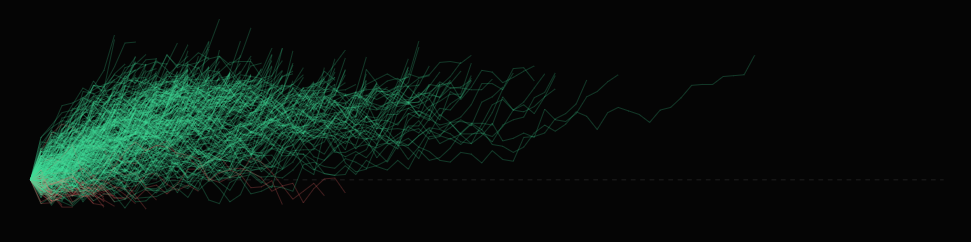
10,000 attempts · 45% win rate · 1.3R · 3 trades/day · 1% risk · the 100k two-step

Thousands of overlapping simulated equity paths for the same trader, fanning out from a shared starting point — most passing (green), a few failing (red)
passedfailed

Pass probability

Per step and overall, each with a Wilson 95% confidence interval — not a single number pretending to be exact.

Failure autopsy

Which rule actually ends attempts: daily-loss breach, max-loss breach, or timeout — broken out separately.

Expected attempts + EV

How many tries a retry-until-you-pass journey costs, with every fee priced in, and the expected value that follows.

Time and stagnation

Average days to pass or fail, and days to a first funded payout at the median.

Funded-life odds

Probability a funded account ever collects a payout, and how often it blows up inside the funded window instead.

Sensitivity

What shifting your own win-rate estimate by a point or two actually costs your odds — made visible, not assumed away.

Built to be checked, not trusted blind.

The simulator above runs the same engine client-side, in your browser — nothing you enter leaves it. Every run is deterministic under its seed, every ruleset names its own source and last-verified date, and anything the engine had to simplify is listed in the result, not buried.

01Pick a challenge
sourced rules, dated and cited
02Enter your stats — or build & backtest
manual entry, or Nuke AI + a real backtest
03Watch thousands of simulated journeys
traced paths against the moving loss floor
04Read the distributions
pass %, attempts, cost, EV — with a seed you can share